discovery :: hegemony :: prophecy :: conspiracy :: eschatology :: anthropology :: cosmology :: philosophy :: epistemology :: teleology  [?]
Showing posts with label climate. Show all posts

Thursday, December 16, 2010

EARTH CHANGES


Golfballs the new hail
Georgia Shield holds several of the golf ball-size hailstones that fell at Logan, south of Brisbane, during a freak storm on the afternoon of December 15, 2010.

Thursday, December 09, 2010

EARTH CHANGES

Eiffel Tower shut and roads blocked by Paris snowfall

Heavy snow in Paris brought buses to a halt on Wednesday, suspended flights at Charles de Gaulle airport and prompted the closure of the Eiffel Tower.Motorways in the Paris region were described as impassable as snow that had already hit other areas of France spread to the capital.

Panama Canal shut by heavy rains

Traffic through the Panama Canal - which connects the Pacific and Atlantic oceans - has been temporarily suspended because of heavy rain.The canal authority said the rains had pushed water levels in lakes that form part of the canal to historic highs, potentially affecting shipping.It is the first time the canal has had to close since the US invasion of Panama in 1989.

Sunday, May 30, 2010

EARTH CHANGES


Uganda's Rwenzori Mountains in 1987 on the left and in 2005 on the right

Uganda's highest ice cap splits on Mt Margherita

The ice cap on Uganda's highest peak has split because of global warming.
The glacier is located at an altitude of 5109m in the Rwenzori mountain range, near the border with the Democratic Republic of Congo.

Scientists say glaciers in the range could disappear within 20 years. According to researchers, the ice cap covered 6 sq km  50 years ago. It is now less than 1 sq km.

Monday, December 01, 2008

EARTH CHANGES

Government reversal on coal mines

There are plans to open more deep mines and extend the few we still have. But deep mines take years to develop and there is a much easier and quicker method of extracting the coal - opencast mining on the surface.

When the government came to power it called the huge excavations of opencast mines "too high a price to pay" in environmental terms.

But as the BBC's Panorama programme reports this week, Whitehall seems to have reversed that election promise and has been giving the go-ahead for more and more opencast mines.

Sunday, November 23, 2008

EARTH CHANGES

Earth shattering dinosaur killer unearthed

Scientists have now discovered the ‘dinosaur extinction layer’ in Montana in the USA, which is a chocolate-coloured strip of rock containing millions of bones.
‘For 30 years, we’ve believed Earth was hit by a giant asteroid that created global warming and killed the dinosaurs, but scientists hadn’t, until now, found any evidence of this.
No one realised that over the millions of years since it hit, any traces would be covered in layers of rock.

Friday, April 18, 2008

EARTH CHANGES

US climate change plan 'disastrous and Neanderthal'

US President George W Bush's plan to cap greenhouse gases by 2025 has been dismissed as "disastrous" and "Neanderthal" by some ministers at a climate change meeting in Paris.

In a statement entitled "Bush's Neanderthal speech," German Environment Minister Sigmar Gabriel said: "His speech showed not leadership but losership. We are glad that there are also other voices in the United States."

South Africa blasted Mr Bush's proposal as a disastrous retreat by the planet's number-one polluter and a slap to poor countries.

Tuesday, August 07, 2007

EARTH CHANGES


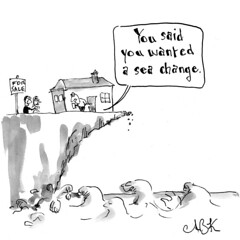
© abk.

Tuesday, July 10, 2007

EARTH CHANGES

Warming waters to drive fish south: CSIRO

A CSIRO study of the waters off the south-east coast of Australia reveals that they are warming up faster than anywhere else in the southern hemisphere.

The scientists warn that these warmer waters will not only dramatically change the marine environment, but could devastate local fisheries.

However fisherman from the area say they are not worried yet because they have just had their best catch in years.

Tuesday, July 03, 2007

EARTH CHANGES

'Scepticism' over climate claims

The public believes the effects of global warming on the climate are not as bad as politicians and scientists claim, a poll has suggested.

The Ipsos Mori poll of 2,032 adults - interviewed between 14 and 20 June - found 56% believed scientists were still questioning climate change.There was a feeling the problem was exaggerated to make money, it found.

The Royal Society said most climate scientists believed humans were having an "unprecedented" effect on climate.

The survey suggested that terrorism, graffiti, crime and dog mess were all of more concern than climate change.

Monday, June 04, 2007

EARTH CHANGES

China puts economy before climate


China says its first and overriding priority in tackling climate change is to maintain economic development.

The remarks come in China's first national plan on climate change.

Friday, May 18, 2007

EARTH CHANGES

Polar ocean 'soaking up less CO2'

One of Earth's most important absorbers of carbon dioxide (CO2) is failing to soak up as much of the greenhouse gas as it was expected to, scientists say.

The decline of Antarctica's Southern Ocean carbon "sink" - or reservoir - means that atmospheric CO2 levels may be higher in future than predicted.

These carbon sinks are vital; they mop up excess CO2 from the atmosphere, slowing down global warming.

[The study, by an international team, is published in the journal Science.]

Monday, May 14, 2007

EARTH CHANGES

Charity warns of migration crisis

The effects of climate change could make at least one billion people homeless between now and 2050, says a charity body.

In a report to mark the start of Christian Aid week, the charity says that forced migration is now the most urgent threat facing poor people in the developing world.

Billions face climate change risk

Billions of people face shortages of food and water and increased risk of flooding, experts at a major climate change conference have warned.

Friday, February 23, 2007

EARTH CHANGES


A chilling possibility

In a 2003 report, Robert Gagosian cites "rapidly advancing evidence [from, e.g., tree rings and ice cores] that Earth's climate has shifted abruptly and dramatically in the past." For example, as the world warmed at the end of the last ice age about 13,000 years ago, melting ice sheets appear to have triggered a sudden halt in the Conveyor, throwing the world back into a 1,300 year period of ice-age-like conditions called the "Younger Dryas." It is also now known that the Gulf Stream weakened in 'Little Ice Age'
On 6 December 2005 Michael Schlesinger, a professor of atmospheric sciences at the University of Illinois at Urbana-Champaign, leading a research team, said "The shutdown of the thermohaline circulation has been characterized as a high-consequence, low-probability event. Our analysis, including the uncertainties in the problem, indicates it is a high-consequence, high-probability event." See also: Failing ocean current raises fears of mini ice age.

Monday, February 19, 2007

EARTH CHANGES

>

After 5m years the ancient Aral sea is now in it's death throes

Once the world's fourth largest lake, the mighty Aral Sea is now in it's death throws. Starved of it's lifeblood of the waters of the Syr Darya and the Amu Darya rivers, the sea has been shrinking for the last 40 years.
From the 1930s, the former Soviet Union started building large scale diversion canals to irrigate vast cotton fields in a grand plan to make cotton a great export earner. This was achieved, and even today Uzbekistan is still a large exporter of cotton. But the cost in ecological and human terms have been astronomical.

[The Aral Sea is one of less than 20 ancient lakes in the world, and is estimated to be more than 5 million years old.]

Friday, August 11, 2006

EARTH CHANGES


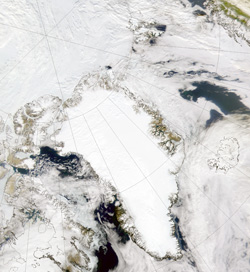
A view of Greenland and its ice sheet from space. If the ice sheet melted, global sea levels would rise an estimated 7 meters (23 feet).

Greenland ice sheets melting: Global warming advances faster than anticipated

As the world digests the flow on from rising petrol prices, the implications of its increased use are also being debated. A new study published in the journal Science reveals that global warming is melting Greenland's ice sheet three times faster than scientists had thought.

Accererating melt

By 2020, the snows of Kilimanjaro may exist only in old photographs. The glaciers in Montana's Glacier National Park could disappear by 2030. And by mid-century, the Arctic Sea may be completely ice-free during summertime. As the earth's temperature has risen in recent decades, the earth's ice cover has begun to melt. And that melting is accelerating.

Sea Levels Likely To Rise Much Faster Than Was Predicted

Global warming is causing the Greenland ice cap to disintegrate far faster than anyone predicted. A study of the region's massive ice sheet warns that sea levels may - as a consequence - rise more dramatically than expected.
Scientists have found that many of the huge glaciers of Greenland are moving at an accelerating rate - dumping twice as much ice into the sea than five years ago - indicating that the ice sheet is undergoing a potentially catastrophic breakup.
The implications of the research are dramatic given Greenland holds enough ice to raise global sea levels by up to 21ft, a disaster scenario that would result in the flooding of some of the world's major population centres, including all of Britain's city ports.

[Glaciers and Sea Ice Endangered by Rising Temperatures]

Monday, July 24, 2006

EARTH CHANGES

Sahara Desert Was Once Lush and Populated

At the end of the last Ice Age, the Sahara Desert was just as dry and uninviting as it is today. But sandwiched between two periods of extreme dryness were a few millennia of plentiful rainfall and lush vegetation.
During these few thousand years, prehistoric humans left the congested Nile Valley and established settlements around rain pools, green valleys, and rivers.
The ancient climate shift and its effects are detailed in the July 21 issue of the journal Science.

[In the 1930s the 'Sleeping Prophet' Edgar Cayce told of the past fertility of the Sahara ... "The Nile entered into the Atlantic Ocean. What is now the Sahara was an inhabited land and very fertile." (Reading #364-13)]

Monday, March 27, 2006

EARTH CHANGES

Global warming yields “glacial earthquakes,” future sea level rise

In new studies, scientists report that global warming may be responsible for a newfound and growing phenomenon, “glacial earthquakes".
Three studies published in the March 24 issue of the research journal Science warn of the events.

Two studies found that the Earth may be warm enough by 2100 for widespread melting of the Greenland Ice Sheet and partial collapse of the Antarctic Ice Sheet.
In a third study, seismologists reported an unexpected offshoot of global warming: “glacial earthquakes,” in which island-sized glaciers lurch unexpectedly. Glaciers are normally slow-moving masses of ice.
The lurches yield temblors up to magnitude 5.1 on the moment-magnitude scale, which is similar to the Richter scale, the researchers said.
 
[Glacial earthquakes in Greenland, they added, are most common in July and August, and have more than doubled in number since 2002.]

Monday, January 30, 2006

EARTH CHANGES

Claims US gagging climate expert

NASA's top climate scientist, James Hansen, director of the US space agency's Goddard Institute for Space Studies, has accused the Bush administration of trying to stop him from speaking out on emissions of greenhouse gases


[Dr Hansen says that "efforts to quiet him" had begun in a series of calls after a lecture he gave on December 6, 2005, at the annual meeting of the American Geophysical Union in San Francisco. ]

Friday, January 27, 2006

EARTH CHANGES

Warming hits 'tipping point'

A vast expanse of western Sibera is undergoing an unprecedented thaw that could dramatically increase the rate of global warming, climate scientists warn today.
Researchers who have recently returned from the region found that an area of permafrost spanning a million square kilometres - the size of France and Germany combined - has started to melt for the first time since it formed 11,000 years ago at the end of the last ice age.

[The area, which covers the entire sub-Arctic region of western Siberia, is the world's largest frozen peat bog and scientists fear that as it thaws, it will release billions of tonnes of methane, a greenhouse gas 20 times more potent than carbon dioxide, into the atmosphere]

Melting of permafrost threatens homes and roads

Global warming could melt almost all of the top layer of Arctic permafrost by the end of the century. Scientists say the thaw would release vast stocks of carbon into the atmosphere, threaten ocean currents and wreck roads and buildings across Canada, Alaska and Russia.